


 Cart
Cart
 sales@molnova.com


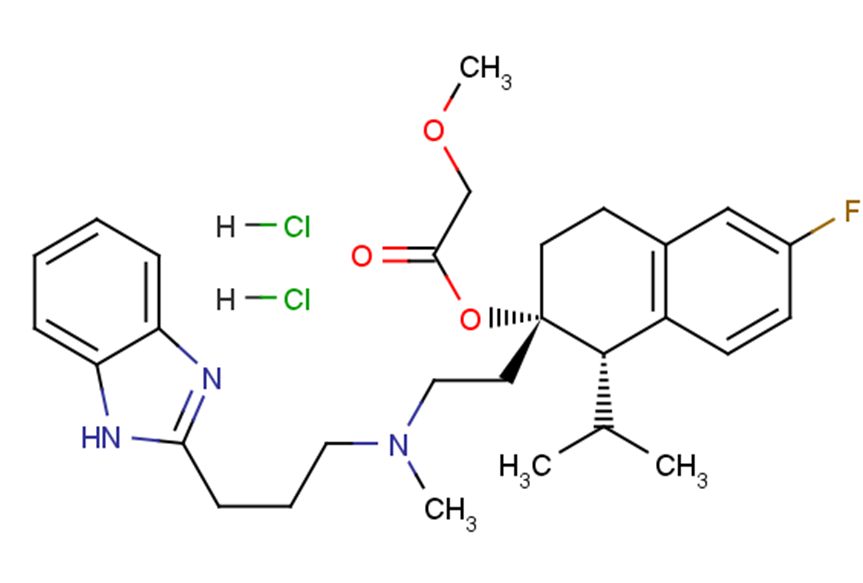
Mibefradil dihydrochloride
CAS No. 116666-63-8
Mibefradil dihydrochloride( Ro 40-5967 (dihydrochloride) )
Catalog No. M22557 CAS No. 116666-63-8
Mibefradil dihydrochloride is an blocker of calcium channel with moderate selectivity for T-type Ca2+ channels (T-type and L-type currents with IC50s of 2.7 μM and 18.6 μM, respectively). Mibefradil dihydrochloride inhibits reversibly the T- and L-type currents with IC50 values of 2.7 and 18.6 μM, respectively.
Purity : >98% (HPLC)
 COA
Datasheet
HNMR
HPLC
MSDS
Handing Instructions
COA
Datasheet
HNMR
HPLC
MSDS
Handing Instructions
| Size | Price / USD | Stock | Quantity |
| 5MG | 83 | In Stock |


|
| 100MG | Get Quote | In Stock |
|
| 200MG | Get Quote | In Stock |
|
| 500MG | Get Quote | In Stock |
|
| 1G | Get Quote | In Stock |
|
Biological Information
-
Product NameMibefradil dihydrochloride
-
NoteResearch use only, not for human use.
-
Brief DescriptionMibefradil dihydrochloride is an blocker of calcium channel with moderate selectivity for T-type Ca2+ channels (T-type and L-type currents with IC50s of 2.7 μM and 18.6 μM, respectively). Mibefradil dihydrochloride inhibits reversibly the T- and L-type currents with IC50 values of 2.7 and 18.6 μM, respectively.
-
DescriptionMibefradil dihydrochloride is an blocker of calcium channel with moderate selectivity for T-type Ca2+ channels (T-type and L-type currents with IC50s of 2.7 μM and 18.6 μM, respectively). Mibefradil dihydrochloride inhibits reversibly the T- and L-type currents with IC50 values of 2.7 and 18.6 μM, respectively..Mibefradil inhibited Orai1, Orai2, and Orai3 currents dose-dependently. The IC50 for Orai1, Orai2, and Orai3 channels was 52.6, 14.1, and 3.8 μM respectively. Outside-out patch demonstrated that perfusion of 10-μM mibefradil to the extracellular surface completely blocked Orai3 currents and single channel activity evoked by 2-APB. Intracellular application of mibefradil did not alter Orai3 channel activity. Mibefradil at higher concentrations (>50 μM) inhibited Ca2+ release but had no effect on cytosolic STIM1 translocation evoked by thapsigargin. Inhibition on Orai channels by mibefradil was structure-related, as other T-type Ca2+ channel blockers with different structures, such as ethosuximide and ML218, had no or minimal effects on Orai channels. Moreover, mibefradil inhibited cell proliferation, induced apoptosis, and arrested cell cycle progression.Compared with the saline-treated group, rats receiving Mibefradil or Ethosuximide show significant lower CaV3.2 expression in the spinal cord and DRG.
-
In Vitro——
-
In Vivo——
-
SynonymsRo 40-5967 (dihydrochloride)
-
PathwayGPCR/G Protein
-
TargetCalcium Channel
-
RecptorT-type calcium channel|L-type calcium channel
-
Research Areanervous system
-
IndicationBrain and Central Nervous System Tumors
Chemical Information
-
CAS Number116666-63-8
-
Formula Weight568.55
-
Molecular FormulaC29H40Cl2FN3O3
-
Purity>98% (HPLC)
-
SolubilityH2O:122 mg/mL (214.58mM)
-
SMILESCl.Cl.COCC(=O)O[C@]1(CCN(C)CCCc2nc3ccccc3[nH]2)CCc2cc(F)ccc2[C@@H]1C(C)C
-
Chemical Name——
Shipping & Storage Information
-
Storage(-20℃)
-
ShippingWith Ice Pack
-
Stability≥ 2 years
Reference
1. Brain KL, et al. The sources and sequestration of Ca(2+) contributing to neuroeffector Ca(2+) transients in the mouse vas deferens. J Physiol. 2003 Dec 1;553(Pt 2):627-35.
molnova catalog



related products
-
Bay K-8644
Bay K-8644 is a potent L-type calcium channels (LTCCs) activator with EC50 of 17.3 nM.
-
N-Desalkylflurazepam
N-Desalkylflurazepam (Norfludiazepam) is a long-acting metabolite of benzodiazepine compounds, such as Flurazepam. N-Desalkylflurazepam inhibits L-type voltage-gated calcium channels with IC 50 values of 55 μM and 37 μM for Ca v 1.2 and Ca v 1.3 , respectively.
-
GV-58
GV-58 is a potent, selective N-Type and P/Q-type Ca2+ Channel agonist with EC50 of 7.2 and 8.8 uM.
